The pages AI cites are usually not yours
When an AI engine recommends a category, the sources it quotes are mostly listicles, review sites, Reddit and YouTube, not the brand’s own homepage. Here is why your perfect site cannot save you if you are missing from the third-party pages the engines actually read, and what to do about it.
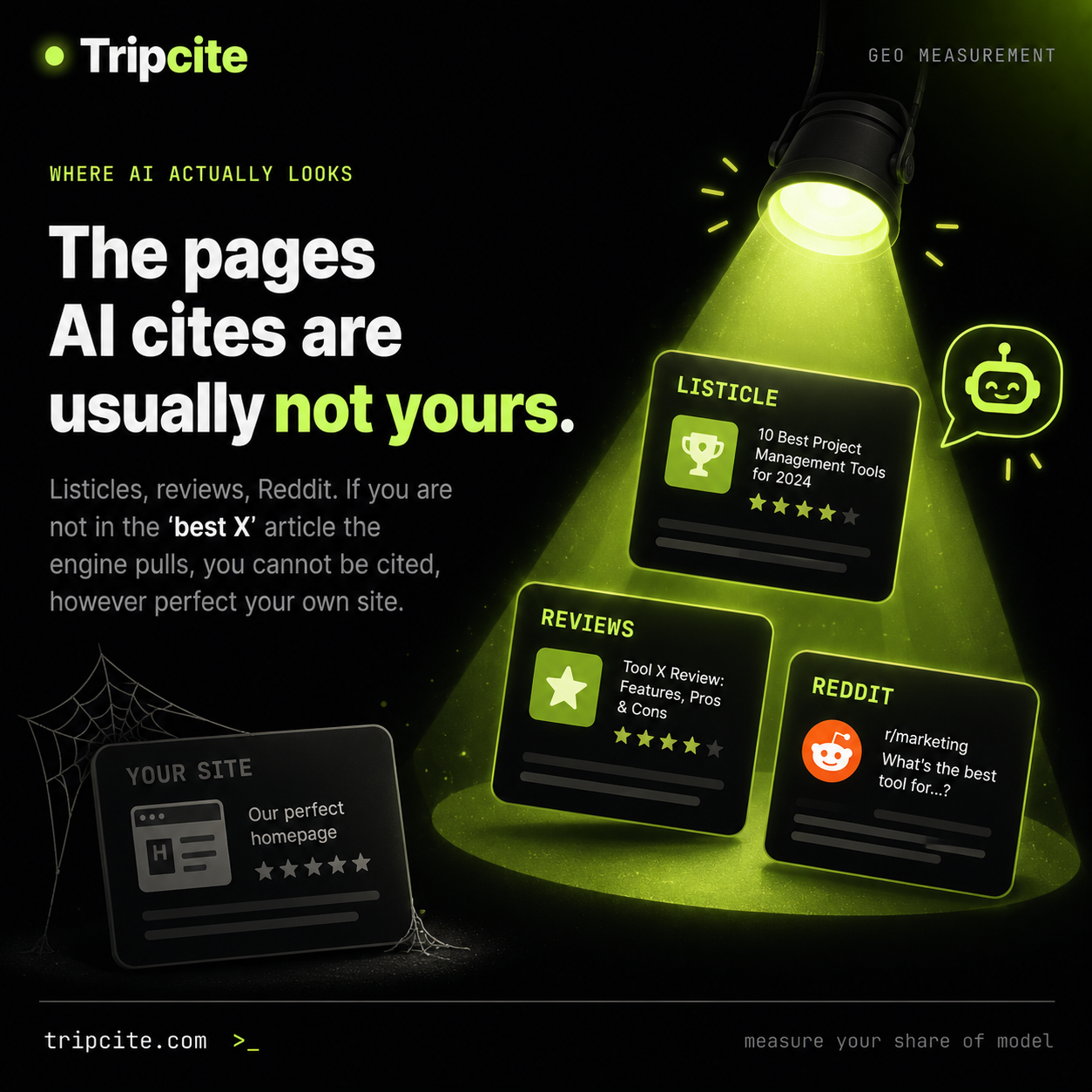
Run an audit on almost any category and the same thing happens. You ask an AI engine the buyer question, you read the answer, and you look at what it cited. The sources are rarely brand homepages. They are listicles, review sites, Reddit threads and YouTube videos. Often a competitor is cited more than the brand itself. If the engine pulls a “best X” article and you are not in it, you cannot be cited, however perfect your own site is.
Where AI actually looks
A live-retrieval engine like ChatGPT with search, Perplexity, Gemini or Google AI Overviews does not answer a category question by reading your website. It runs a search, pulls a handful of pages that already rank for that question, and writes an answer grounded in what those pages say. The pages that rank for “best project management tool” or “top softball tour company” are almost never a single vendor’s homepage. They are:
- Listicles. “10 best X for 2026” roundups from blogs, trade press and affiliate sites.
- Review sites. G2, Capterra, Trustpilot, TripAdvisor and category-specific directories.
- Community threads. Reddit, Quora, niche forums and Facebook groups where real buyers compare options.
- Video and social. YouTube reviews and comparisons, increasingly quoted for consumer categories.
These are the pages the engine reads. Your homepage is one voice claiming you are good. A listicle that names ten options and puts you third is a neutral third party doing the comparison the buyer asked for, which is exactly why the engine trusts it more.
Why a perfect site is not enough
You can do everything right on your own domain. Answer-first passages, clean schema, an answer-first chunk structure, a fast site, an llms.txt file. All of that helps the engine understand you once it is already reading your page. It does nothing about the prior step: whether your page is in the retrieval set at all.
For a category question, the retrieval set is decided by third-party pages. If “best X” returns five listicles and you appear in none of them, the engine has nothing of yours to quote. It will confidently recommend the brands those articles name, and describe them well, because it has good source material about them and none about you. Your on-site work never gets a turn.
The two questions every audit should answer
Once you accept that citations come from other people’s pages, the useful question is not “is my site optimized?” It is:
- Which pages does the engine actually read for my category? Not the pages you wish it read. The exact URLs it cites when a buyer asks the question.
- Am I on those pages, and how do I rank inside them? Being mentioned in position nine of a “top ten” is not the same as being the article’s pick.
This is why Tripcite reports the citation sources behind every answer, not just whether your brand was named. Once you can see the real source list, the off-site work stops being guesswork. You know which listicles to get into, which review profiles are thin, and which Reddit thread is quietly shaping the answer.
Winning the pages you do not own
This is closer to digital PR and reputation work than to classic SEO, and it is the highest-leverage GEO work for a known brand. A practical order of operations:
- Get into the listicles that already rank. Find the “best X” articles the engine cites and earn a place in them: a pitch to the author, a corrected omission, a genuinely better entry. One inclusion can change every answer that pulls that page.
- Fix your review-site presence. A category-review profile with four reviews loses to a rival with two hundred. The engines read the aggregate, so the review gap is often the single biggest lever, and it is one you can close deliberately.
- Show up where buyers already ask. The Reddit and forum threads that rank for your category are being read verbatim. Being a helpful, named presence there is worth more than another blog post on your own domain.
- Seed the comparison content that does not exist yet. If no neutral “X vs Y” page exists for your category, the engine will quote whatever thin thing it can find. A well-made comparison, even one you commission, becomes source material.
On-site still matters, for the other half of the game
None of this means your own site is optional. Off-site work wins the category questions, the ones where the engine searches the web and builds an answer from third-party pages. Your own pages still win the branded and long-tail questions, where someone asks about you specifically or about a narrow problem you cover better than any listicle. And the two reinforce each other: a strong on-site presence makes it easier to earn the third-party mentions, and vice versa. The mistake is thinking a perfect homepage covers you when the buyer asks the category question. It does not. We cover the full split in SEO vs GEO: what changes, and how to attack each.
Start by seeing who the engines actually cite
Before you commission a single piece of content, find out which pages the engines quote for your category today, and whether you appear on them at all. That source list is the map for every off-site move worth making. See how to build it in How to measure your AI search visibility, or look at two real, public audits we ran: MyCantera and Odisea Tours. Tripcite tracks your share of model across ChatGPT, Perplexity, Gemini and Claude, and shows you the exact citation sources behind every answer, so you know which pages to win, and they are usually not yours.
What is your share of model?
See how often ChatGPT, Perplexity, Gemini and Claude cite your brand versus your competitors. Get a baseline audit.